On this page
- What WhatsApp marketing actually includes
- The rules that decide everything
- What it costs in 2026
- Setting up: from nothing to first campaign in a day
- Broadcasts that get read
- Sequences: the follow-ups nobody remembers to send
- Chatbots and AI: the marketing that happens in replies
- Click-to-WhatsApp ads
- Selling inside the conversation
- Fifteen campaigns by industry
- Measuring it properly
- What changed in 2025 and 2026
- Mistakes that end WhatsApp marketing programmes
- What VGraple CRM does here
Too long? Read this
- WhatsApp marketing is permission-based: every promotional message needs a prior opt-in, an approved template outside the 24-hour window, and an opt-out line
- It costs Rs 0.8631 per marketing message in India (Meta's card effective 1 October 2026), utility messages Rs 0.115, and replies inside a customer's 24-hour window are free for the first 1,000 a month on each number, then Rs 0.115; a platform fee comes on top
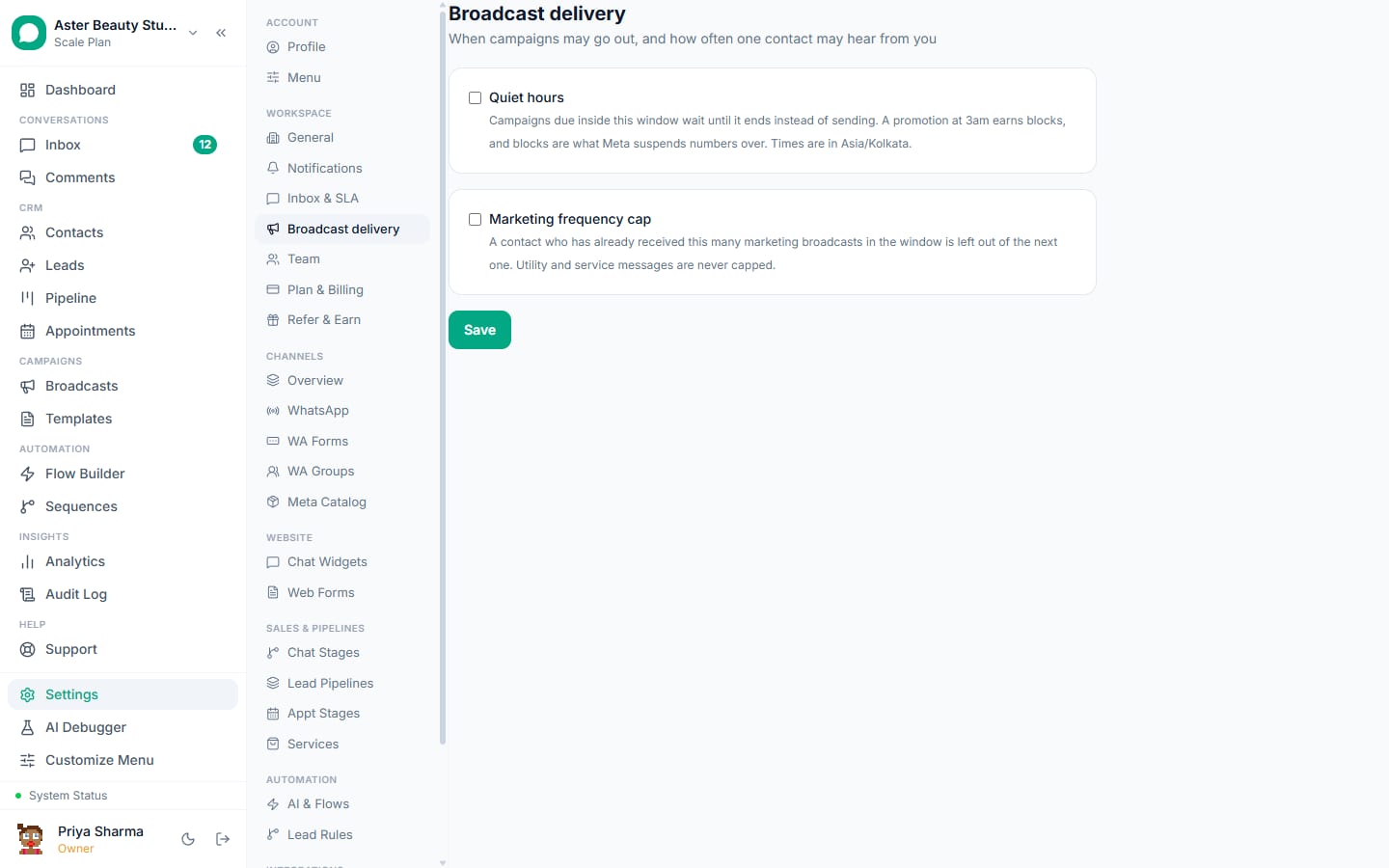
- Meta's messaging tiers, per-user frequency cap and quality rating decide how much you can send and to whom; sending inside them is a system problem, not a discipline problem
- The five channels that make up WhatsApp marketing (broadcasts, sequences, chatbots, click-to-WhatsApp ads, in-conversation selling), how to measure them, and 15 campaigns by industry
WhatsApp marketing is reaching customers who agreed to hear from you, on the app they open forty times a day, with messages that are read within minutes instead of days. In India, where WhatsApp is the default way to talk to a business, it is the highest-engagement channel a small or mid-size company can run. It is also a permission channel with hard rules: every promotional message needs an opt-in, an approved template outside a 24-hour window, an opt-out line, and a sender whose quality Meta rates continuously. This guide explains how it works in 2026, what it costs, what the rules are, which campaigns work by industry, and how to measure it, written from running the channel for hundreds of Indian businesses.
What WhatsApp marketing actually includes
Five things, which most guides blur together.
| Channel | What it is | Needs a template? | Typical result |
|---|---|---|---|
| Broadcasts | One template to a segment of opted-in contacts | Yes | 60 to 80 percent read, 3 to 10 percent reply |
| Sequences | Timed follow-ups after a trigger (lead, purchase, no-show) | Yes, for steps outside the 24-hour window | 2 to 4x the conversion of a single message |
| Chatbots and AI | Automated conversations that qualify, answer and book | No, inside the window | Instant replies at any hour, 40 to 80 percent of enquiries resolved |
| Click-to-WhatsApp ads | Facebook and Instagram ads that open a chat | No, the customer starts the chat | Lower cost per lead than form ads, attributable revenue |
| In-conversation selling | Catalog messages, payment links, quotes inside chat | No, inside the window | Shorter sales cycle, measurable revenue per agent |
A business that only runs broadcasts is doing a fifth of WhatsApp marketing and paying the most for it. The rest of this guide covers all five.
The rules that decide everything
Opt-in
Practical opt-in sources in India: a checkbox on your website and order forms, a click-to-WhatsApp ad (the click plus the first message is the opt-in), a QR code at the counter or on packaging, a "Reply YES to get updates" message inside an existing conversation, and imports of customers who have previously messaged you. Purchased lists are not opt-in, and they are the fastest way to a restricted number.
The 24-hour window and templates
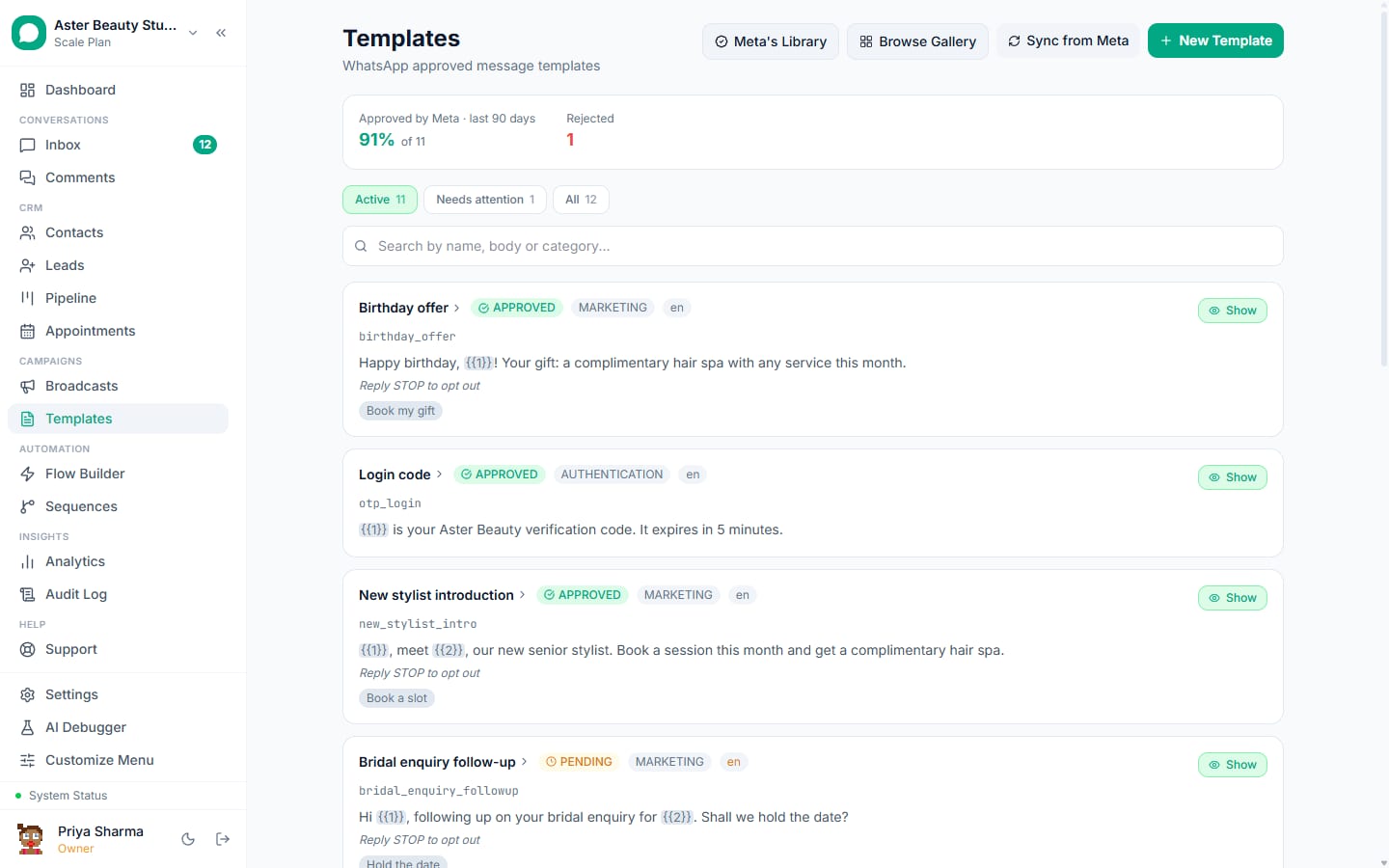
This one rule shapes the economics: conversations that customers start can continue without templates, at no cost for each number's first 1,000 replies a month and Rs 0.115 per reply after that from 1 October 2026; messages you start cost more and need a template. The template library has 75 approved-style templates; 20 template examples that get approved explains the review.
Messaging tiers
Your business portfolio has a limit on unique customers you can start conversations with per rolling 24 hours: 250 (unverified), 1,000, 10,000, 100,000, unlimited. Meta raises it as you use it with good quality. Since October 2025 it is per portfolio, not per number.
The per-user frequency cap
Meta limits how many marketing messages a WhatsApp user receives from all businesses combined. When a user is at the cap, your marketing message is not delivered (error 131049). Engaged contacts are rarely capped; cold contacts often are. Utility messages are never capped.
Quality rating
Blocks and spam reports lower the quality rating of your number from High to Medium to Low, which lowers your tier and can pause templates or restrict the account. Everything below is designed to keep it High.
What it costs in 2026
Meta bills per delivered template message, at the recipient country's rate, to your Meta Business account.
| Message type | India rate (card effective 1 October 2026) | 1,000 messages | 10,000 messages |
|---|---|---|---|
| Marketing template | Rs 0.8631 | Rs 863 | Rs 8,631 |
| Utility template | Rs 0.115 | Rs 115 | Rs 1,150 |
| Authentication template | Rs 0.115 | Rs 115 | Rs 1,150 |
| Free-form reply inside the 24-hour window | First 1,000 a month per number at no charge, then the utility rate (from 1 October 2026) | Same | Same |
Then the platform fee. Resellers (BSPs) typically add 10 to 25 percent to Meta's rates or sell expiring credits; Tech Providers connect your own account and charge a flat fee. VGraple CRM charges Rs 0 on the free plan and Rs 1,499 to Rs 7,999 on paid plans with no per-message markup; the pricing page shows three worked months and the calculator does your numbers. Other countries: rates by country.
The cost lever most businesses miss: move transactional messages (bookings, orders, payments, reminders) to utility templates at a seventh of the price and outside the marketing cap, and drive replies so follow-ups happen inside the 24-hour window as replies rather than templates.
Setting up: from nothing to first campaign in a day
- Choose the API route. The free WhatsApp Business app handles broadcast lists of 256 saved contacts and nothing else; for marketing you need the API through a platform. If the phone app matters to you, connect in coexistence mode and keep it.
- Connect the number. Meta Embedded Signup takes about 15 minutes for a new number. Business verification (documents in Meta Business Manager) raises your tier and unlocks the display name; do it in week one.
- Build the opt-in base. Add the website checkbox, the QR code and the ad; import existing customers who have messaged you. Tag every contact with the source.
- Get three templates approved: a utility update relevant to your business, a welcome message, and one promotional template with an opt-out line.
- Run a utility campaign first to existing customers. It warms the number, raises the tier and costs almost nothing.
- Then the first broadcast to the people who replied, at 11 am on a weekday, with one clear ask and a button.
Details for each step: connect your number, create your first template, send your first broadcast.
Broadcasts that get read
A broadcast is one template to a segment. What separates a 78 percent read rate from a 45 percent one:
- Segment, do not blast. Recent buyers, repliers to the last campaign, people who asked about a category. Sending everything to everyone is how the frequency cap and the block button find you.
- The first line is the notification. WhatsApp shows roughly 60 characters. Put the value there, not "Hi {{name}}, greetings from".
- One ask, one button. A quick-reply button ("Send me the catalogue") turns a read into a 24-hour conversation you can continue without templates.
- Time it. 10 am to 1 pm and 6 pm to 8 pm on weekdays perform best for Indian consumer lists; nothing after 9 pm. Send-time optimisation sends each contact at the hour they historically respond.
- Suppress before sending. Opted-out, blocked, capped and unreachable contacts should never be attempted; they are wasted money and, worse, spam-report risk.
- Read the per-recipient result, not just the totals. "Suppressed" and "failed" mean different things and need different follow-ups.
The full walkthrough: how to set up a WhatsApp broadcast campaign. The engineering behind it: delivery protection.
Sequences: the follow-ups nobody remembers to send
A drip sequence is a series of timed messages after a trigger: a new lead, a form submission, an abandoned cart, a missed appointment, a purchase. The economics are better than broadcasts because the trigger is a signal of interest, and the first step usually lands inside a window the customer opened.
Example
Coaching institute lead sequence: minute 0, thank you plus batch details (an in-window reply, no template); day 1, counsellor introduction template with a "Book a call" button; day 3, a student result story template; day 7, fee deadline reminder template. STOP at any point cancels the rest.
Rules that keep sequences safe: stop on opt-out, never re-enrol someone who finished, cap the number of marketing steps, and use utility templates for the informational steps.
Chatbots and AI: the marketing that happens in replies
Most WhatsApp marketing revenue is made in the reply, not the broadcast. A chatbot flow answers the price, timing and availability questions that follow a broadcast at any hour, qualifies the lead in three questions and books the slot. An AI chatbot trained on your price list and FAQs handles the questions you did not script, and hands over to a person on the rules you set. Both run inside the 24-hour window, so no template is needed after the first message. From 1 October 2026 Meta charges for replies too; the first 1,000 each month on each WhatsApp number are free. After that each reply costs the utility rate, so bots that answer fully in one message cost least.
Click-to-WhatsApp ads
A click-to-WhatsApp ad on Facebook or Instagram opens a chat instead of a landing page. Three reasons it is the fastest-growing part of WhatsApp marketing in India: the click is the opt-in, the first message arrives with the ad's referral data so you can attribute the conversation and its revenue to the ad, and Meta's Conversions API lets you send purchase events back so the campaign optimises for buyers rather than clickers. Pair it with a welcome flow that answers in seconds; leads from ads decay within minutes.
Selling inside the conversation
WhatsApp is the only channel where the catalogue, the quote, the payment link and the receipt can all sit in one thread. Catalog messages show products with prices inside chat; payment links close the sale without leaving it; the resulting revenue is attributed to the conversation, the campaign and the agent in revenue tracking. For a salon or a D2C store this is the difference between "we got replies" and "we made Rs 1.2 lakh from Tuesday's broadcast".
Fifteen campaigns by industry
Each names the trigger, the template category and the follow-up.
- Salon: monthly offer to clients who visited in the last 90 days (marketing); reply opens booking flow.
- Salon: 24-hour appointment reminder (utility); reply "reschedule" routes to the desk.
- Dental clinic: six-month recall to patients due for a check-up (utility, information they expect).
- Cosmetic clinic: post-procedure day-3 check-in (utility) with a "book follow-up" button.
- Real estate: new launch to enquirers tagged with the location (marketing); site-visit booking flow.
- Real estate: site-visit confirmation and directions (utility).
- Coaching institute: batch-start reminder to enquirers (marketing); fee deadline (utility) to enrolled students.
- D2C fashion: abandoned-cart nudge within 2 hours (utility if it states the cart, marketing if it adds a discount).
- D2C fashion: back-in-stock alert to people who asked (utility).
- Restaurant: weekend menu to opted-in diners (marketing); table confirmation (utility).
- Travel agency: itinerary and document checklist (utility); seasonal packages to past travellers (marketing).
- Gym: renewal reminder 7 days before expiry (utility); referral offer to active members (marketing).
- Jewellery: festival collection to past buyers (marketing); order-ready pickup notice (utility).
- B2B SaaS: renewal and invoice reminders (utility); webinar invitation to customers (marketing).
- NGO: donation receipt (utility); campaign update to donors who opted in (marketing).
Templates for the first five industries are in the library; industry playbooks are under Solutions.
Measuring it properly
Track the funnel per campaign and the money per campaign.
| Metric | Healthy range (opted-in Indian list) | What a miss means |
|---|---|---|
| Delivered | 92 to 97 percent | Stale numbers, capped recipients, tier exhausted |
| Read within 24 hours | 60 to 80 percent | Wrong time, weak first line, disengaged list |
| Replied or clicked | 3 to 10 percent (marketing), higher for utility | No clear ask, no button |
| Blocks and reports | Under 0.2 percent | Unsolicited or too frequent |
| Revenue attributed | Depends on business | The only metric that settles the budget |
Read rate is a floor, not a truth: users who turn off read receipts never show as read. Judge campaigns by replies and revenue. How to measure WhatsApp marketing ROI goes deeper, and why open rates drop covers the common decline.
What changed in 2025 and 2026
- July 2025: Meta moved from conversation-based to per-message pricing for templates. Replies inside the window stayed free, and utility templates inside an open window became free.
- October 2026: From 1 October 2026 Meta charges for replies too; the first 1,000 each month on each WhatsApp number are free. Utility templates are charged per delivered message, including inside the 24-hour window, from 1 October 2026. See Meta's 1 October 2026 pricing change.
- October 2025: Messaging limits moved to the business-portfolio level.
- 2025 onward: Per-user marketing frequency caps expanded; error 131049 became the most common delivery failure for cold lists.
- April 2026: Meta's India rate card published directly in INR; utility rates reduced relative to marketing, widening the gap that rewards transactional messaging.
Mistakes that end WhatsApp marketing programmes
- Buying a list. Everything downstream fails.
- Sending promotions as "utility" to save money. Meta reclassifies and the cap applies anyway.
- One number, one tier, ten brands. Portfolio-level limits mean a spammy sister brand throttles you.
- Ignoring "suppressed". Retrying those recipients cannot succeed and wastes sends.
- No human path in the chatbot. Enquiries that cannot reach a person leave for a competitor.
- Judging by read rate. Judge by replies and revenue.
What VGraple CRM does here
Every channel in this guide is on the platform, including on the free plan: broadcasts with suppression, pacing, tier budgeting and auto-pause; sequences with STOP handling; the flow builder and the AI chatbot; click-to-WhatsApp referral capture with Conversions API events; catalog and payment links in chat; and revenue attribution per campaign and agent. Meta's message charges are billed by Meta with no markup. Start on the free plan, connect your number in 15 minutes, and run the utility campaign first.