On this page
- What you get
- How it works
- What are the six scoring factors, exactly?
- Why is engagement worth 40 of the 100 points?
- Does the score decay if a lead goes quiet?
- How does the score relate to pipeline stage and revenue?
- With VGraple CRM vs sorting leads by gut feel
- Who uses it
- What Meta allows
- Plans and limits
- Recent improvements
In short
- A rule-based, explainable 0-100 score, not an opaque AI prediction, built from six weighted factors you can see broken down on every lead
- Hot is 70 and above, warm is 40 to 69, cold is below 40
- Recalculates on lead creation and on every inbound reply, plus a background sweep that keeps recency-based signals current without hammering the database
Lead scoring gives every lead a 0-100 number that tells your team who to call first, and unlike most CRM scoring, it's not a black box: every point comes from a named, weighted factor you can see broken down on the lead itself. A lead with a phone number, a WhatsApp conversation, a reply sent three days ago and a booked appointment will show exactly why it scored 78 rather than making you trust an opaque prediction.
What you get
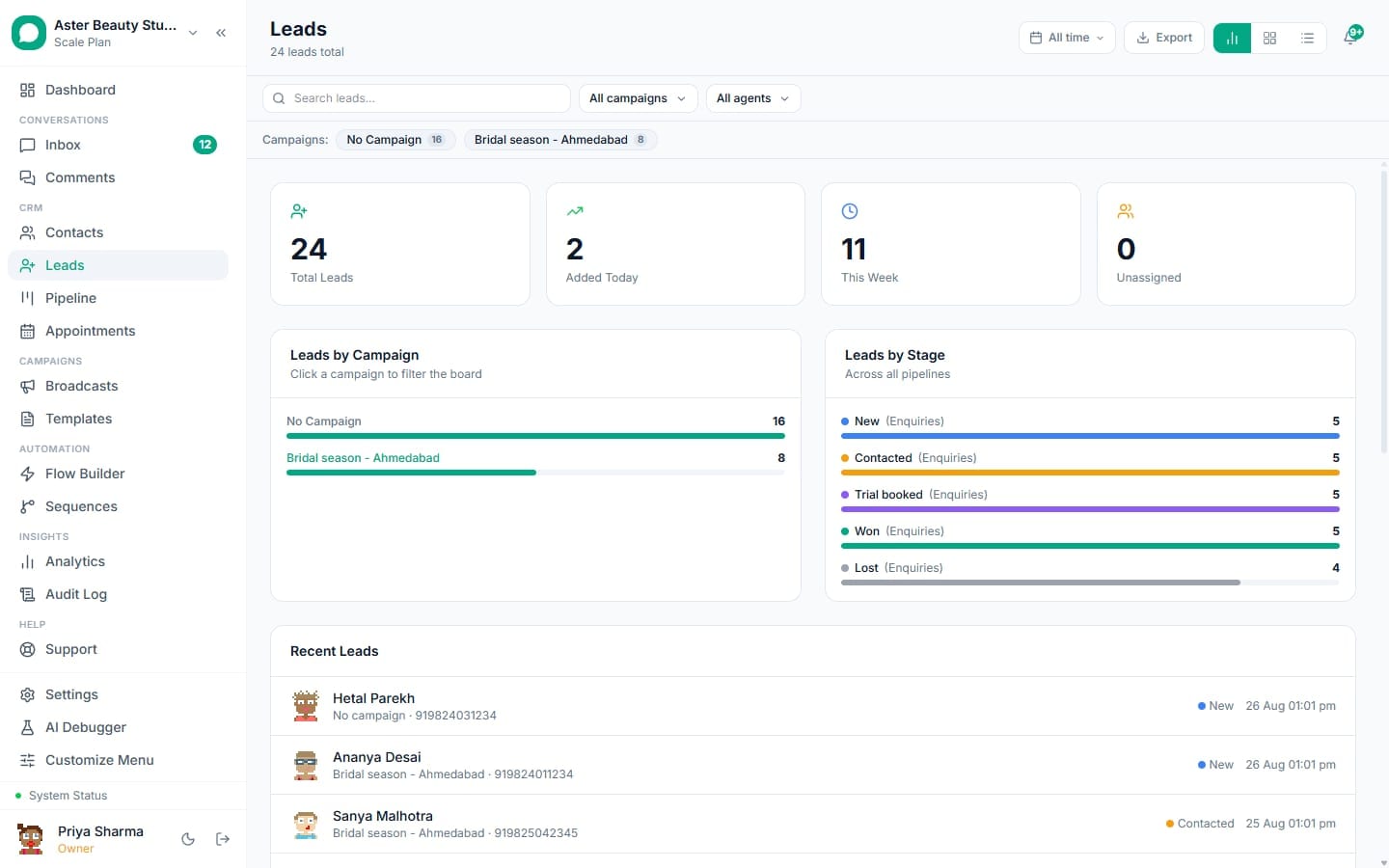
- A visible 0-100 score on every lead card, table row and detail panel, color-coded hot, warm or cold
- A factor-by-factor breakdown (contact details, source quality, form completeness, engagement, pipeline stage, actions) with a progress bar for each
- Automatic recalculation on lead creation and on every inbound reply, plus a background sweep for time-based decay
- A manual recalculate button on the lead detail panel for on-demand refreshes
- Fixed, documented temperature thresholds: hot at 70+, warm at 40-69, cold below 40
How it works
- A lead is created and scored immediately. The moment a lead lands in the pipeline, from any of the six sources, its score computes from whatever signals already exist: does it have a phone, an email, a linked WhatsApp contact, how many form answers came with it, and what its source is worth.
The score updates the moment they reply. An inbound WhatsApp message from the lead's linked contact triggers an immediate rescore, adding engagement points for the reply itself and for how recently it happened.
Stage progress and actions add more signal as the lead advances. Moving a lead further along its pipeline stages, booking an appointment, or generating a tracked revenue event all add points the next time the score recalculates.
A background sweep keeps recency current even when nothing new happens. Scores older than 24 hours are picked up in batches so a lead that's gone quiet sees its recency-based engagement points decay without anyone having to trigger it.
Sort and filter your pipeline by score. Use the visible hot/warm/cold badge on the board or table view to decide who to work first, without opening every lead individually.
Recalculate on demand when you know something the system doesn't. After manually adding a phone number or logging an appointment that happened outside the platform, hit the recalculate button on the lead's score panel to reflect it immediately.
What are the six scoring factors, exactly?
Contact details (up to 15 points): 8 for having a phone number, 4 for an email, 3 for a real WhatsApp contact. Lead source (up to 15): manual and referral sources score 15, web chat and web form score 12, Meta Lead Ad and other generic sources score 8. Form completeness (up to 10): 2.5 points per answered form question, capped at 4 questions. Engagement (up to 40, the largest single category): 10 for having opted in, 15 for having sent at least one inbound message, up to 10 more scaled by recency (3 days or less scores highest, tapering to 3 points at up to 30 days), and 5 more for 3 or more inbound messages. Pipeline stage (up to 10): scaled by how far through the pipeline's stages the lead has moved. Actions (up to 10): 5 for a booked appointment, 5 for a tracked revenue event.
Example
A lead from a Meta Lead Ad campaign, with a phone number, no email, who has replied twice and is sitting halfway through a 4-stage pipeline with no appointment yet, would score roughly 8 (source) + 8 (contact) + 15+6+5 (engagement, replied, recent, sustained) + 5 (stage halfway) = 47, landing in the warm band.
Why is engagement worth 40 of the 100 points?
Contactability and source tell you whether a lead is reachable and where it came from, but neither tells you whether the person is actually interested. Engagement, whether they've opted in, whether they've replied, and how recently, is the closest signal available to real buying intent, so it carries the largest weight by a wide margin. A lead with a perfect source and full contact details but zero replies will still land in the cold or low-warm band, because the model treats silence as the strongest negative signal it has.
Example
Two leads both come from the same Meta Lead Ad campaign with complete contact details. One replied to the welcome message within an hour; the other never opened WhatsApp. The first scores roughly 30 points higher purely on the engagement factor.
Does the score decay if a lead goes quiet?
Yes, on the recency component specifically. The 10 points available for recency taper as time passes since the lead's last inbound message: full credit inside 3 days, partial credit out to 7 and then 30 days, and none beyond that. Because a background sweep rescoring stale leads runs continuously in the background (touching only scores older than 24 hours, in batches, so it never rewrites the entire table on every tick), a lead's score reflects genuine current engagement rather than a snapshot frozen the day they first replied.
Watch out
A lead that scored hot two weeks ago and hasn't replied since will drift down toward warm or cold as the recency factor decays, even with no new activity. Check "last message" alongside the score, not the score alone, when deciding who to re-engage.
How does the score relate to pipeline stage and revenue?
Two of the six factors are pulled directly from what's already happening elsewhere in the platform rather than being scored independently: pipeline stage progress uses the lead's actual position among its pipeline's stages (0 at the first stage, full credit at the last), and the actions factor checks the linked contact's real appointment and revenue history through the appointments and revenue tracking features. This keeps the score honest, a lead can't score high on "actions" without an actual booked appointment or a tracked payment behind it.
With VGraple CRM vs sorting leads by gut feel
| Sorting leads manually | VGraple CRM lead scoring | |
|---|---|---|
| Deciding who to call first | Whoever looks promising, or first-in-first-out | Sorted by a visible 0-100 score |
| Explaining why a lead is prioritized | "It felt like a good one" | Six named factors with point values, visible per lead |
| Accounting for a reply | Have to remember to check the thread | 15 of 40 engagement points, automatically |
| Accounting for staleness | Nobody notices until someone checks manually | Recency component decays automatically via a background sweep |
| Weighing a booked appointment or a sale | Manual judgment call | 5 fixed points each, tied to real records |
| Auditing the score | Not possible, there's nothing to audit | Every point is a labeled factor with a progress bar |
Who uses it
Real-estate agencies juggling dozens of active leads across several projects use score sorting to work the hottest buyers first instead of working the pipeline in arrival order. See WhatsApp automation for real estate.
Coaching institutes with high lead volume from Meta ads use the score to separate genuinely engaged prospects from ad clicks that never replied. See WhatsApp automation for education and coaching.
Clinics scoring leads that have booked an appointment higher than ones that haven't lets front-desk staff focus outbound calls on people who dropped off before actually attending. See WhatsApp automation for healthcare.
D2C stores running several ad campaigns at once compare average lead scores per campaign to see which one is bringing in genuinely engaged buyers versus cheap, low-intent clicks. See WhatsApp automation for ecommerce.
What Meta allows
Plans and limits
Lead scoring is available on every plan, including Free, with no separate gate or usage cap. It runs automatically on every lead your org creates, regardless of plan tier.
Recent improvements
- 2026-08: Rewrote the periodic score sweep to batch database reads and writes instead of rescoring one lead at a time, cutting a job that previously rewrote the entire Lead table every few minutes down to only the leads whose score had actually gone stale.
- 2026-08: Added the manual recalculate action on the lead detail panel's score section.
- 2026-07: Score now recalculates on inbound replies in addition to lead creation, so engagement points reflect activity in near real time rather than only at intake.