On this page
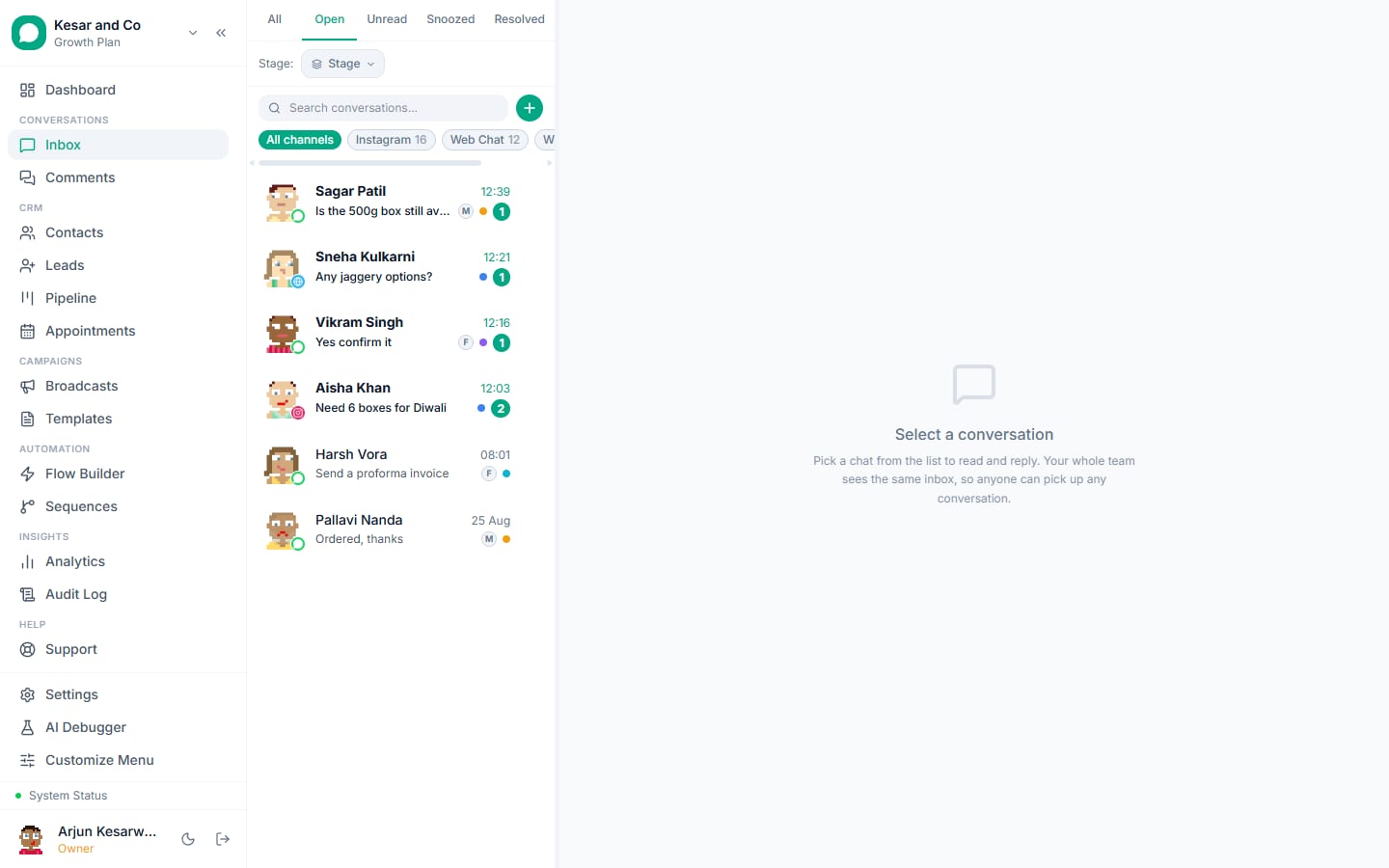
In short
- Order and shipping updates as utility templates from store events; support with order lookup in the inbox
- Abandoned cart recovery is marketing under Meta's rules: consent, one nudge, an opt-out
- Campaigns to consenting customers with carousels and catalog messages; purchases sent to Meta
E-commerce stores use WhatsApp for the messages customers actually want (order confirmed, shipped, delivered, where is my order) and for the sales moments that convert (the cart nudge, the drop, the ad conversation). VGraple CRM connects the store's events, the catalog and the Conversions API, runs support with order lookup in the inbox, and keeps campaigns inside Meta's rules; the outcome is fewer support tickets, more direct orders and a number that stays green.
The problem in numbers
Stores feel WhatsApp in support first: "where is my order" is the most common ticket in the category, and every one is avoidable with a shipping update sent at the moment the status changes. Carts abandoned at checkout are the second: a single nudge recovers a meaningful share, but Meta classifies it as marketing, so it needs consent and an opt-out. Campaigns are where numbers get hurt: a launch to every past buyer draws blocks, pauses the template and drops the quality rating. Meta's pricing shapes the answer: utility at Rs 0.115 for everything about the customer's own order, marketing at Rs 0.8631 only to people who asked.
Six things e-commerce teams automate on WhatsApp
1. Order and shipping updates from store events
Shopify or WooCommerce events arrive through Zapier or webhooks; each status sends a utility template: confirmed, packed, shipped with a tracking URL button, out for delivery, delivered.
order_shipped (utility)
Order {{1}} is on its way with {{2}}. Track it: {{3}}. Expected by {{4}}.
Shopify, WooCommerce and automation rules.
2. Order lookup in chat
A 'Track my order' button asks the order number and reads the status through a webhook node; the AI answers shipping and return policy questions from the knowledge base and hands anything else to support.
order_status (session reply)
Order {{1}} is {{2}}. Expected delivery {{3}}. Reply if anything looks wrong.
Flow builder with webhook nodes; AI chatbot.
3. Abandoned cart, once, with consent
An hour after a cart is abandoned by a customer who consented to marketing, one marketing template with the cart and a payment link; no second nudge; an opt-out line.
cart_reminder (marketing)
Hi {{1}}, your cart at {{2}} is waiting: {{3}}. Complete it here: {{4}}. Reply STOP to opt out.
Store events with a Delay step and consent check under automation rules.
4. Selling inside WhatsApp
Catalog messages show products with prices; customers build a cart and send it; a payment link closes the order and triggers the confirmation.
order_confirmed (utility)
Hi {{1}}, order {{2}} is confirmed: {{3}}. We will message you when it ships.
5. Ad conversations with the Conversions API
Click-to-WhatsApp ads open a free window of up to 7 days; the flow shows products and closes the sale; the purchase goes back to Meta so the ad set learns to find buyers.
ad_welcome (session reply)
Hi {{1}}, welcome to {{2}}. Tap Browse to see the collection or Track to check an order.
Click-to-WhatsApp ads and revenue tracking.
6. Campaigns to consenting customers
Once or twice a month, a carousel or catalog template to consenting customers segmented by category and engagement, paced and held by delivery protection, with a retarget two days later.
new_collection (marketing)
Hi {{1}}, the {{2}} collection is live at {{3}}. Reply SHOP to see it or STOP to opt out.
Broadcasts and delivery protection.
Feature map
| Job | Feature | Plan |
|---|---|---|
| Order and shipping updates | Store integrations, automation rules | Free |
| Order lookup and policy answers | Flow builder, AI chatbot | Free; AI uses AI credits |
| Abandoned cart with consent | Automation rules, sequences | Free |
| Catalog and payments in chat | Catalog, payments | Free |
| Ads with the Conversions API | Click-to-WhatsApp ads, revenue tracking | Free |
| Campaigns with delivery protection | Broadcasts | Free within Meta limits |
| Support team of 5 to 15 | Seats | Starter to Growth |
What it costs
A store with 2,000 orders a month sends four utility messages per order, 8,000 in all at Rs 0.115, charged inside the window too from 1 October 2026: Rs 920. Order questions come to about 4,000 replies: 1,000 free a month, 3,000 at Rs 0.115 (Rs 345). One cart nudge to 800 consenting abandoners costs Rs 690; one campaign to 10,000 consenting customers Rs 8,631. Meta charges nothing for ad conversations inside the free entry point window (up to 7 days). Meta's total is about Rs 10,586 a month. VGraple CRM is Rs 1,499 on Starter for a small support team and Rs 3,499 on Growth for a larger one, with the AI on AI credits on either plan; Meta bills directly with no markup.
A 30-day rollout plan
Week 1. Connect the number and the catalog; submit the templates; connect store events; build the greeting and order lookup flow; put the widget on the storefront.
Week 2. Order and shipping templates on store events; support routing; AI for policy questions.
Week 3. Consent collection at checkout and after the first order; the cart nudge with a consent check; click-to-WhatsApp ads with the Conversions API.
Week 4. First campaign to consenting customers with a retarget; review ticket volume, cart recovery, cost per purchase and blocks.
Getting the number ready
Most e-commerce businesses already run WhatsApp on the owner's phone, so the first decision is how to connect: coexistence keeps the WhatsApp Business app working on that phone while the team uses the inbox, with up to six months of history imported; an API-only connection suits a new number for the team. Either way, Embedded Signup takes a few minutes, the display name is reviewed by Meta, and business verification in Meta Business Manager lifts the marketing limit from 250 unique recipients a day to 1,000 and beyond. Submit the templates on day one; most are approved within the hour, and the template library has an industry collection ready to submit.
Consent, privacy and the rules that apply
A customer who messages first has consented to service replies and to utility messages about that transaction; marketing needs an explicit yes, recorded with source and date, and an opt-out on every marketing template. VGraple CRM records consent automatically from inbound messages, YES replies, forms, ads and imports, suppresses opted-out and blocked contacts before every send, honours STOP and Meta's app-level opt-out at once, and keeps marketing to United States numbers paused as Meta requires. Personal fields are encrypted at rest, access is by role and team, and the audit log records exports and deletions, which covers India's DPDP Act and GDPR for e-commerce data in practice. The opt-in rules guide has the detail.
Numbers to watch each week
First-response time on new conversations (minutes, not hours); the share of enquiries that reach the step that matters for e-commerce (a booking, a visit, an order, an enrolment); utility messages sent; how much of each number's 1,000 free replies a month is used (the number's card in Settings shows it); replies to the last marketing send; and blocks on it, which should stay under 0.2 percent. The Analytics page shows them per agent and per campaign on Starter and above; the channel page shows the quality rating and tier, which the blocks feed. A yellow rating is the signal to tighten the segment before the next send, not after.
Common mistakes
- Offers inside shipping updates.
- Cart nudges to customers who never consented to marketing, or more than one nudge.
- Campaigns to every past buyer.
- Support answering 'where is my order' by hand; send the update when the status changes.
- Resending a campaign that was held; let delivery protection finish.
Why VGraple CRM for e-commerce
Store integrations by Zapier and webhooks, catalog messages, payment links, flows with webhook nodes, the AI for policy questions, click-to-WhatsApp capture with the Conversions API, broadcasts with consent, retargeting and delivery protection, and the shared inbox with Instagram are on every plan; the AI uses AI credits, 1,000 free each month. The abandoned cart guide and the D2C fashion playbook go deeper.