On this page
In short
- Lead qualification and document collection with restricted access; EMI, premium and renewal reminders as utility messages
- Authentication templates for OTPs; service requests routed by team; everything logged
- Marketing only to consenting customers; no sensitive financial data in templates or broadcasts
Lenders, insurers, advisors and fintechs use WhatsApp for lead qualification, KYC document collection, EMI and premium reminders, OTPs and service requests, all of which are utility or authentication messages about the customer's own account. VGraple CRM runs them from your core system through the API, with consent, encryption, roles and an audit log built in; the outcome is faster onboarding, better collections and a communication trail your compliance team can read.
The problem in numbers
Financial businesses have the most to gain and the most to protect on WhatsApp. Reminders about an EMI or a premium sent as utility messages are read and acted on far more than SMS; OTPs on WhatsApp are cheaper and deliver better; KYC documents collected in chat arrive the same day rather than the same week. The risks are equally clear: sensitive data in a template, marketing to customers who did not consent, and no record of who sent what. The rules that make it safe are the rules Meta already enforces (utility for the customer's own account, marketing only with consent) plus the controls a regulated business expects: encryption, roles, an audit log and a data processing agreement.
Six things finance and fintech teams automate on WhatsApp
1. Lead qualification with restricted access
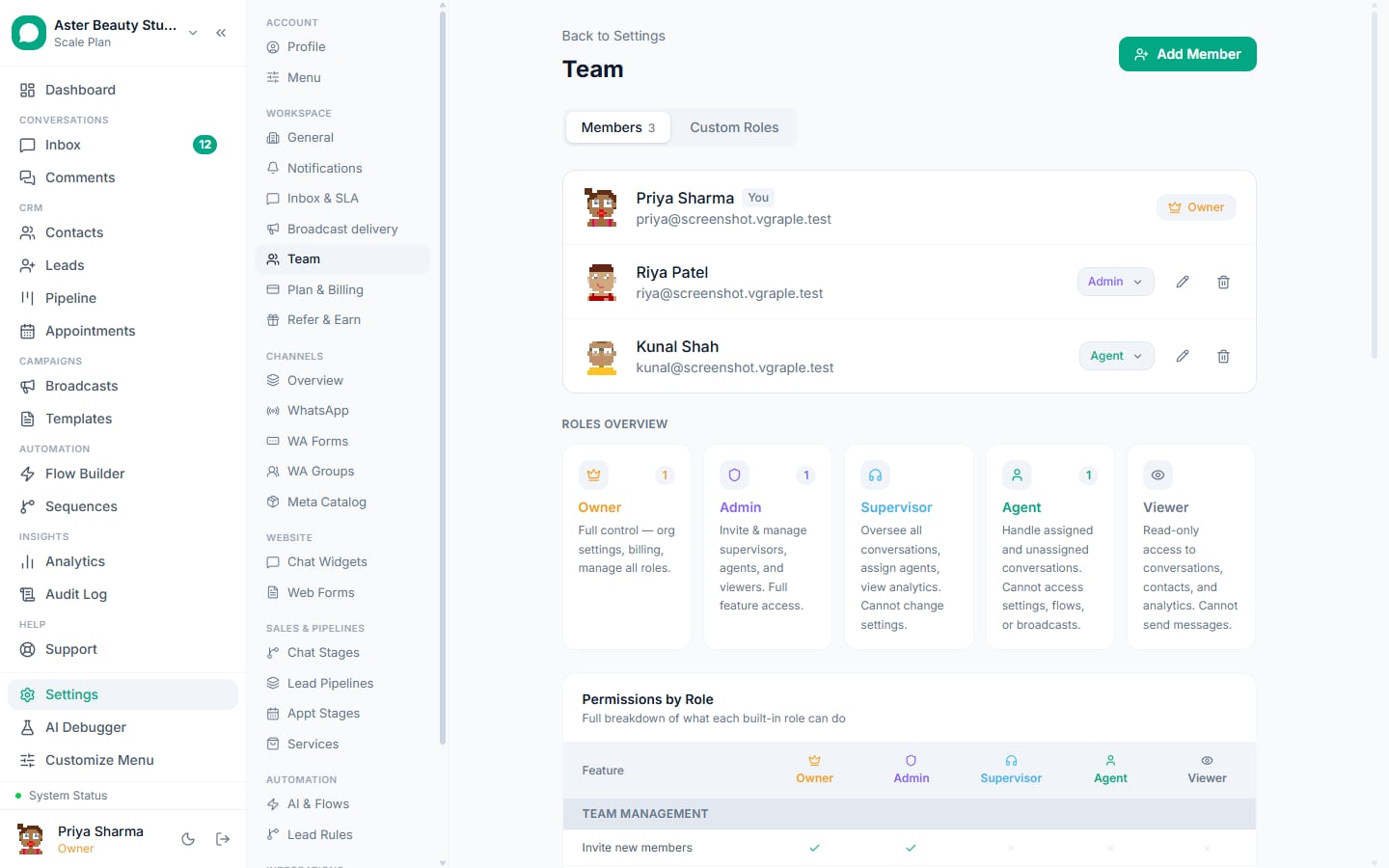
A click-to-WhatsApp ad, a website form or a first message starts a flow: product, amount, city, employment type; the lead is scored and assigned; documents requested through a utility checklist with reply-to-upload land on the lead with access limited to the underwriting team.
fin_document_checklist (utility)
Hi {{1}}, to process your {{2}} application we need: {{3}}. Reply with clear photos of each. Your documents are visible only to our verification team.
Flow builder, leads, security and roles.
2. EMI and premium reminders
From the account record's due dates: a utility reminder three days before with a payment link, on the day, and once after; payment through the link updates the record; overdue beyond a set period assigns collections.
fin_emi_reminder (utility)
Hi {{1}}, your EMI of Rs {{2}} for account ending {{3}} is due on {{4}}. Pay here: {{5}}. Reply if you need help.
Payments, timers under automation rules, or events from your core system through the REST API.
3. OTPs with authentication templates
One-time passcodes through Meta's authentication format with copy-code or one-tap buttons, sent from your system through the API.
fin_otp (authentication)
{{1}} is your verification code. For your security, do not share this code. It expires in 10 minutes.
Templates with the authentication preset; the API.
4. Renewals with a payment link
Insurance and subscription renewals 30, 7 and 1 days before expiry with a link; a lapsed policy gets a utility notice and then only marketing with consent.
fin_renewal (utility)
Hi {{1}}, your {{2}} policy {{3}} renews on {{4}}. Premium Rs {{5}}. Renew here: {{6}}.
Timers from the policy record; sequences.
5. Service requests routed by team
Balance, statement, address change and complaint requests arrive as messages; keywords and buttons route them to the right team; statements are sent inside the conversation the customer opened, never as a broadcast.
fin_statement_ready (utility)
Hi {{1}}, your statement for {{2}} is ready. Reply STATEMENT to receive it here securely.
Team inbox with routing rules and stages; the AI chatbot for FAQs.
6. Product offers with consent only
Cross-sell and offers as marketing templates to customers who consented, segmented by product, with an opt-out; never inside a utility message.
fin_offer (marketing)
Hi {{1}}, you are pre-approved for {{2}} up to Rs {{3}}. Reply APPLY to start or STOP to opt out.
Broadcasts with consent and delivery protection.
Feature map
| Job | Feature | Plan |
|---|---|---|
| Qualification and KYC collection | Flow builder, leads, security and roles | Free |
| EMI, premium and renewal reminders | Payments, automation rules, API | Free |
| OTPs | Authentication templates, API | Free |
| Service requests by team | Team inbox, routing rules | Free |
| Core system integration | REST API, webhooks | Free |
| Offers with consent | Broadcasts, delivery protection | Free within Meta limits |
| Audit log, encryption, DPA | Security and roles | Free |
| Sales, service and collections teams | Seats | Growth to Scale |
What it costs
A lender with 5,000 active accounts: three EMI reminders per account per month at Rs 0.115 (15,000 utility, about Rs 1,700); 2,000 OTPs (Rs 230); KYC checklists for 600 applications (Rs 70); one consented offer campaign to 3,000 customers (Rs 2,589). Meta's total is about Rs 4,600 a month; VGraple CRM is Rs 3,499 on Growth or Rs 7,999 on Scale for larger teams with unlimited seats.
A 30-day rollout plan
Week 1. Connect the number; submit utility and authentication templates; set teams and roles for sales, service, underwriting and collections; connect the core system through the API for due-date events.
Week 2. EMI or premium reminders live with payment links; OTPs through the API; the qualification flow.
Week 3. KYC checklist with restricted access; service request routing; the AI for FAQs.
Week 4. Renewal sequences; consent collection for offers; review collections lift, onboarding time and escalations.
Getting the number ready
Most finance and fintech businesses already run WhatsApp on the owner's phone, so the first decision is how to connect: coexistence keeps the WhatsApp Business app working on that phone while the team uses the inbox, with up to six months of history imported; an API-only connection suits a new number for the team. Either way, Embedded Signup takes a few minutes, the display name is reviewed by Meta, and business verification in Meta Business Manager lifts the marketing limit from 250 unique recipients a day to 1,000 and beyond. Submit the templates on day one; most are approved within the hour, and the template library has an industry collection ready to submit.
Consent, privacy and the rules that apply
A customer who messages first has consented to service replies and to utility messages about that transaction; marketing needs an explicit yes, recorded with source and date, and an opt-out on every marketing template. VGraple CRM records consent automatically from inbound messages, YES replies, forms, ads and imports, suppresses opted-out and blocked contacts before every send, honours STOP and Meta's app-level opt-out at once, and keeps marketing to United States numbers paused as Meta requires. Personal fields are encrypted at rest, access is by role and team, and the audit log records exports and deletions, which covers India's DPDP Act and GDPR for finance and fintech data in practice. The opt-in rules guide has the detail.
Numbers to watch each week
First-response time on new conversations (minutes, not hours); the share of enquiries that reach the step that matters for finance and fintech (a booking, a visit, an order, an enrolment); utility messages sent and how many were free inside open windows; replies to the last marketing send; and blocks on it, which should stay under 0.2 percent. The Analytics page shows them per agent and per campaign on Starter and above; the channel page shows the quality rating and tier, which the blocks feed. A yellow rating is the signal to tighten the segment before the next send, not after.
Common mistakes
- Account numbers, balances or sensitive data in templates or broadcasts.
- Offers inside reminder templates.
- Marketing to customers who consented only to account messages.
- Documents visible to everyone; restrict by role.
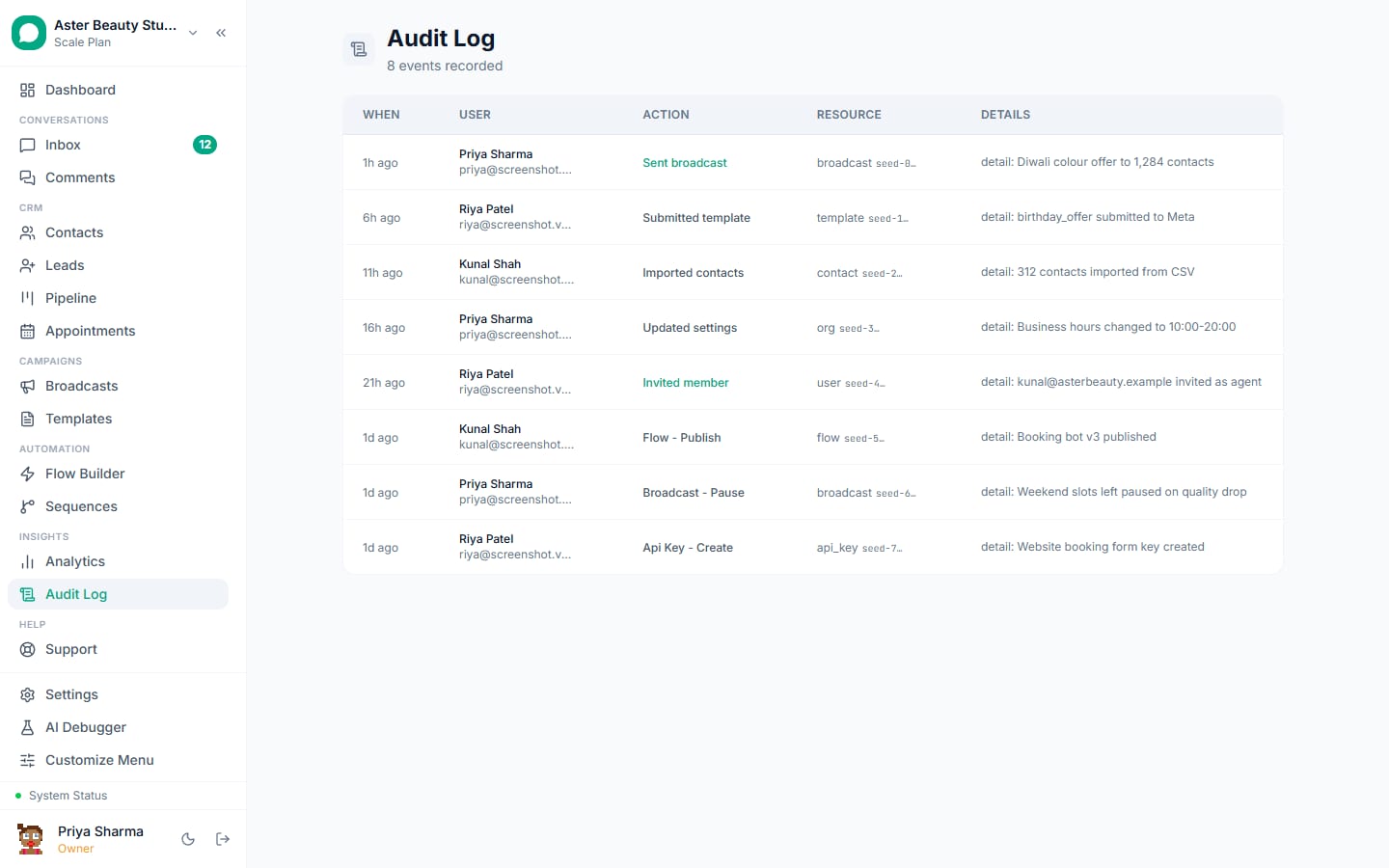
- No audit trail; the audit log exists for the regulator's question.
Why VGraple CRM for finance and fintech
Utility and authentication templates with a validator, payment links, flows with document collection, teams and roles with encryption and an audit log, the REST API and webhooks for core systems, sequences that pause on reply, the AI for FAQs, and broadcasts with consent and delivery protection are on every plan; Growth and Scale fit regulated teams. The security page and the DPA cover the controls in detail.