On this page
Too long? Read this
- Clinics use WhatsApp for booking, reminders, pre-visit instructions, reports, post-visit check-ins and recalls; all are utility messages (Rs 0.115) and most run from appointment stages
- Reminders at 24 hours and 2 hours with a reschedule reply cut no-shows by a third or more; recalls at 6 months fill the diary
- Patient consent is collected at registration, health details stay out of templates, and the AI answers logistics only, never symptoms
- Six templates, the privacy rules, a cost example for a 3-doctor clinic and a 30-day rollout
A clinic's WhatsApp is mostly logistics: book the slot, remind the patient, tell them how to prepare, say the report is ready, check in after the procedure, recall them in six months. Every one of those is a utility message (Rs 0.115 in India, free inside the 24-hour window a patient opens), most fire automatically from appointment stages, and together they cut no-shows by a third and empty the front desk's phone queue. The rules matter more here than anywhere: consent at registration, clinical details kept out of templates and broadcasts, and an AI that answers logistics and never symptoms. This playbook gives the flows, six templates that pass review, the privacy rules, a cost example and a 30-day rollout.
The appointment cycle on WhatsApp
| Moment | Message | Category | Trigger |
|---|---|---|---|
| Enquiry | Doctors, hours, fees, directions; booking flow | Free-form (in-window) | Patient's first message, QR, website widget |
| Booking | Confirmation with date, doctor, location, reply to reschedule | Utility | Appointment created |
| 24 hours before | Reminder with reschedule reply | Utility | Appointment stage timer |
| 2 hours before | Short reminder | Utility | Timer |
| Preparation | Pre-visit or pre-procedure instructions | Utility | Stage "confirmed" for procedures |
| After the visit | Report ready, prescription, care instructions, check-in | Utility | Stage "completed", report upload |
| Recall | Six-month check-up due | Utility | Timer from last visit |
| Missed | "We missed you, reply with a day to rebook" | Utility | Stage "no-show" |
Booking flow
Trigger: any first message, the website widget or the QR at reception. Steps: new or existing patient; department or doctor as a list; date and slot (a WhatsApp Flow form or buttons); name and one line on the reason (optional, never required); confirmation. Emergencies: any message matching emergency words gets the emergency number and a person immediately, before anything else. The appointment is created with stage "Scheduled" and the reminder timers start.
Reminders that actually cut no-shows
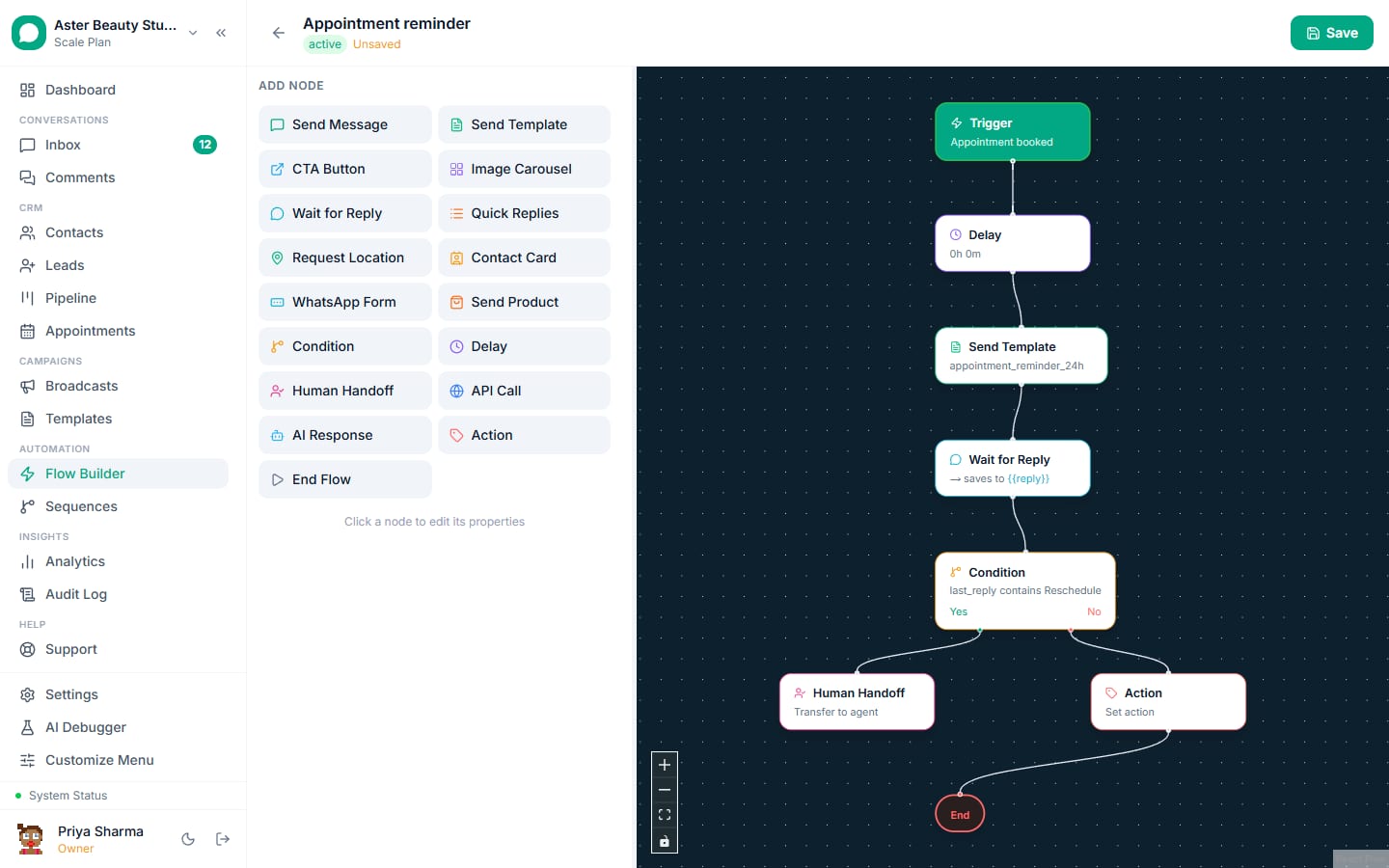
Two reminders, both with a reschedule option: 24 hours before ("Reply R to reschedule") and 2 hours before. The reschedule reply is what changes behaviour: a patient who can move the slot in one tap does not simply not turn up. Reschedule replies land with the desk in the inbox with the appointment card one click away; the new slot triggers a fresh confirmation. Clinics typically see no-shows fall from 15 to 25 percent to under 10.
Reports, instructions and check-ins
- Pre-procedure instructions at stage "confirmed": fasting, medication, what to bring; utility template with a "questions" reply.
- Report ready: a utility template with a reply button; the report itself is sent inside the conversation the patient opens by replying, so it travels in a patient-initiated thread, not a broadcast.
- Post-visit check-in at day 2 or 3: "How are you feeling after {{1}}? Reply if anything concerns you"; replies go to the nurse.
- Recall at six months: slots offered as buttons.
Consent and privacy
Collect the phone number and WhatsApp consent at registration, naming the message types. Record the consent source and date on the contact. Keep clinical detail out of templates, broadcasts and the AI's knowledge base. Restrict who can see conversations by role and team (reception, nurses, doctors); the audit log records access. Personal fields are encrypted at rest. Security and roles covers the controls; the DPA covers processing.
The AI, kept to logistics
Upload hours, doctors and specialities, fees, insurance and TPA lists, directions, parking, preparation instructions and the report-collection process. Escalation rules: any symptom word, medication question, "emergency", "pain", "bleeding", a request for a doctor. The AI's introduction says it handles appointments and information and that a person is one word away. It answers in the patient's language and pauses when a person joins.
Six templates that pass review
- clinic_appointment_confirmed (utility): "Dear {{1}}, your appointment with {{2}} is confirmed for {{3}} at {{4}}. Reply R to reschedule."
- clinic_reminder_24h (utility): "Reminder: {{1}} with {{2}} tomorrow at {{3}}. Reply R to reschedule or C to confirm."
- clinic_reminder_2h (utility): "Your appointment with {{1}} is in 2 hours at {{2}}. See you soon."
- clinic_pre_procedure (utility): "Hi {{1}}, before your {{2}} on {{3}}: {{4}}. Reply with any questions."
- clinic_report_ready (utility): "Hi {{1}}, your {{2}} report is ready. Reply REPORT to receive it here or collect it at reception."
- clinic_recall (utility): "Hi {{1}}, your {{2}} check-up with {{3}} is due. Reply with a preferred day and we will confirm a slot."
What it costs: a 3-doctor clinic
900 appointments a month: confirmation, two reminders and a check-in or report message (3,600 utility messages, Rs 414); 150 recalls (Rs 17); enquiries and reschedule conversations free in-window. Meta total about Rs 430. VGraple CRM from Rs 0 (Free) to Rs 1,499 (Starter) depending on conversation volume. A single avoided no-show per day pays for the month.
30-day rollout
Week 1. Connect the number (coexistence if reception's phone must keep the app); add the consent line to the registration form; submit the six templates; set appointment stages and reminder timers.
Week 2. Booking flow live from the QR and the website widget; confirmations and reminders on; desk handles reschedule replies from the inbox.
Week 3. Report-ready and pre-procedure messages; roles and teams for reception, nurses and doctors; AI for logistics with escalation rules.
Week 4. Recalls to patients due; review no-show rate, reschedule replies, escalations; add the Android app for on-call staff.
Mistakes
- Clinical details in a template or a broadcast.
- Reminders without a reschedule reply.
- The AI answering symptoms.
- Marketing camps to patients who consented only to appointment messages.
- Everyone seeing every conversation; use teams and roles.
What VGraple CRM does here
Appointments with services, staff, stages and reminder timers, WhatsApp Flow forms for booking, utility templates with a validator, the AI chatbot with escalation rules, teams and roles, encryption at rest, the audit log and the shared inbox with the Android app are on every plan including Free (AI on Growth and above). The healthcare solution page has the full setup.