On this page
- Side by side
- Broadcast lists: fine for regulars, wrong for marketing
- Groups: communities, never customer lists
- Channels: a newsletter inside WhatsApp
- API campaigns: the one built for business messaging
- Decision table by use
- Moving from broadcast lists to API campaigns
- Groups and Channels alongside a CRM
- Common questions from Indian businesses
- Costs, for the API route
- Privacy, in one paragraph
- The one-line rule for each
- What VGraple CRM does here
Too long? Read this
- Broadcast lists send private one-to-one copies to up to 256 saved contacts from the app; groups put everyone in one shared chat; Channels are one-way public feeds; API campaigns are template messages to opted-in contacts at any scale
- For a business, groups expose customers to each other and are not for marketing; Channels reach followers without consent records; broadcast lists cap at 256 and need saved contacts
- API campaigns are the only route with consent, personalisation, per-recipient reporting and Meta's delivery rules built in
- A decision table by use case, and what each costs
There are four ways to send one message to many people on WhatsApp, and they are built for different things. A broadcast list (in the WhatsApp Business app) sends private copies to up to 256 saved contacts. A group puts everyone in one shared chat where every member sees every message. A Channel is a one-way public feed people follow. An API campaign sends approved template messages to any number of opted-in contacts through a platform, with consent, personalisation and per-recipient reporting. For a business talking to customers, the choice comes down to privacy, consent, scale and measurement, and only one of the four has all four.
Side by side
| Broadcast list (app) | Group | Channel | API campaign | |
|---|---|---|---|---|
| Who sees whom | Private copies; recipients see only you | Everyone sees everyone | Followers see the channel; not each other | Private copies; recipients see only you |
| Recipients | Up to 256 saved contacts per list | Up to 1,024 members | Unlimited followers | Opted-in contacts within Meta tiers (250 to unlimited per day) |
| Must have your number saved | Yes | No, but must join | No, must follow | No |
| Consent record | None | None (adding without consent is a violation) | None | Recorded per contact |
| Personalisation | No | No | No | Template variables per recipient |
| Replies | Private, to you | In the group | Reactions only | Private, into a shared inbox |
| Reporting | Ticks per chat | None | Follower count, reactions | Sent, delivered, read, replied, clicked, failed per recipient |
| Scheduling and automation | No | No | No | Yes |
| Cost | Free | Free | Free | Meta per-message rate plus platform fee |
| Risk | Bans for spammy use | Privacy exposure, spam reports | Low | Managed by quality rating and tiers |
Broadcast lists: fine for regulars, wrong for marketing
The app's broadcast list is a private-copy send to people who saved your number, capped at 256 per list. No consent record, no personalisation, no reporting beyond ticks, no scheduling, and messages to people who have not saved you vanish silently. It works for a salon's forty regulars or a tuition centre's one batch. It is the wrong tool for marketing to hundreds, and heavy use of many lists gets numbers banned.
Groups: communities, never customer lists
A group is a shared room. Every member sees every message and every member's number. For a business that means customers exposed to each other, replies visible to all, and no control over what members post. Adding customers without consent violates WhatsApp's terms. Groups are right for a class batch, a residents' association, a team, an event's attendees who chose to join; they are wrong for anything that resembles a customer list.
Channels: a newsletter inside WhatsApp
A Channel is a one-way feed: you post, followers see it in the Updates tab and react with emoji. No replies, no consent records (following is the opt-in), no personalisation, no per-follower data. It is good for a brand's announcements to an audience that wants a feed, and useless for anything that needs a reply, a record or attribution. Run one alongside, not instead of, customer messaging.
API campaigns: the one built for business messaging
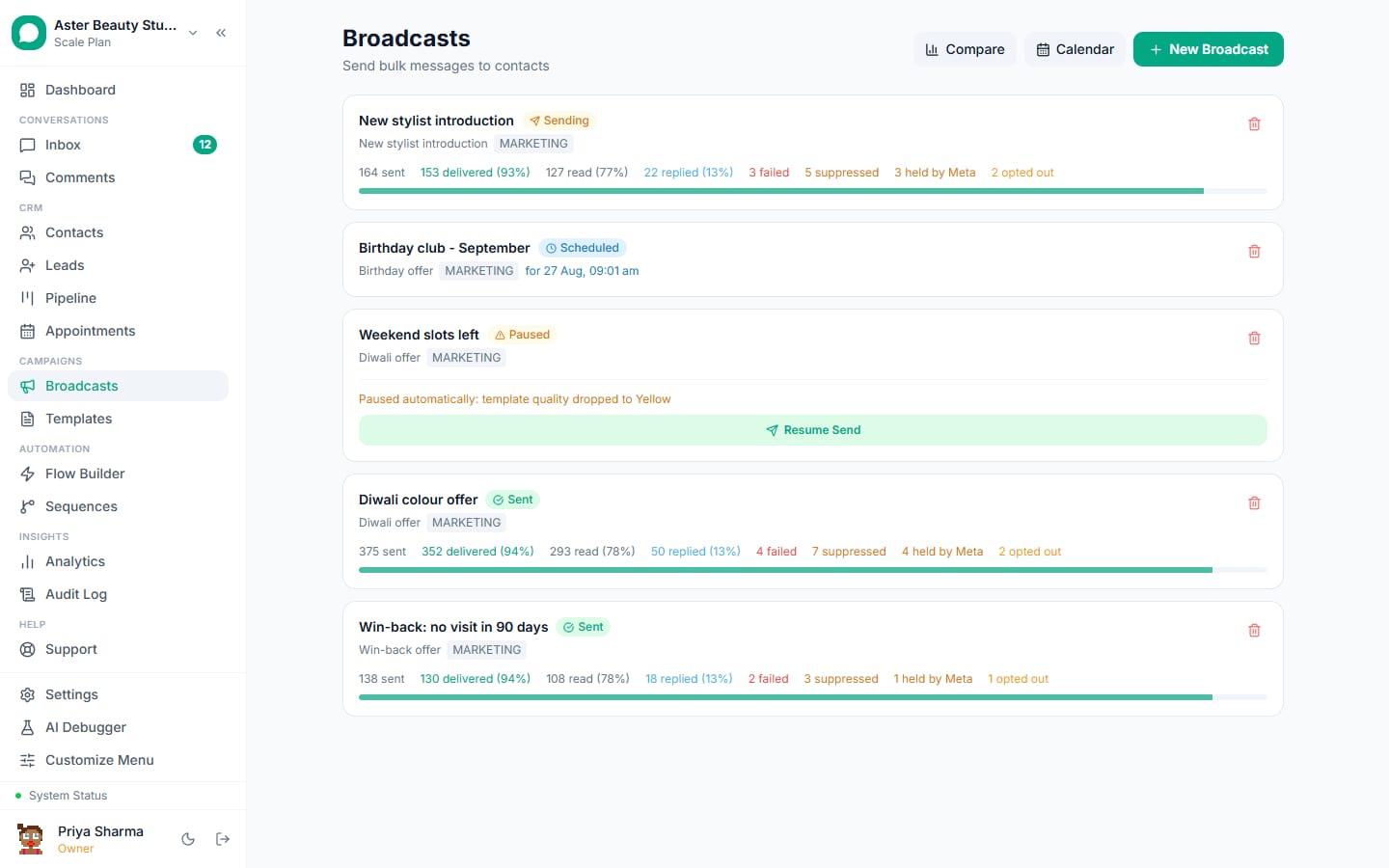
An API campaign sends an approved template to opted-in contacts at any scale your messaging tier allows, personalised per recipient, scheduled, with every recipient's status and reply reported, and with Meta's rules (consent, templates, tiers, quality, frequency caps) enforced by the platform. It costs Meta's per-message rate (India: Rs 0.8631 marketing, Rs 0.115 utility) plus a platform fee, and it is the only option that produces revenue you can attribute. The complete broadcast guide covers setup; delivery protection covers the rules.
Decision table by use
| Use | Pick | Why |
|---|---|---|
| Monthly offer to customers | API campaign | Consent, personalisation, reporting, opt-out handling |
| Order and booking updates | API campaign (utility) | Per-recipient, cheap, expected by the customer |
| Announcements to a public audience | Channel | Free, one-way, scales without consent records |
| A class, batch or project team | Group | Members need to talk to each other |
| Forty regulars, one salon chair | Broadcast list | Free, saved contacts, small |
| Event-day logistics for attendees who joined | Group or API campaign | Group if discussion is wanted; campaign if not |
| Lead follow-ups | API sequence | Timed, personalised, stops on reply |
Moving from broadcast lists to API campaigns
The migration is mostly consent. Broadcast-list contacts saved your number, which is not a recorded opt-in. Send one message from the app inviting them to reply YES to keep getting updates on WhatsApp (that reply is the opt-in and opens a window), or add the opt-in to the next touchpoint (invoice, QR at the counter, website form). Import the contacts with the source and consent recorded, tag them by list, and run the first API campaign as a utility message they expect (a booking reminder, an order update) before any promotion. Keep the app on the phone with coexistence if the owner wants it; the inbox sees everything either way.
Groups and Channels alongside a CRM
Neither is reachable from the API, so neither shows in a shared inbox or reports per member. Treat them as distribution, not as customer data: a Channel post that says "reply on WhatsApp to book" turns followers into inbox conversations where consent, history and revenue are recorded; a group for a batch or an event can point to the business number for anything individual. The rule of thumb: announcements can be one-to-many anywhere; anything about one customer goes through the API.
Common questions from Indian businesses
Can I export my group members into a campaign list? No; group membership is not consent, and exporting numbers from a group to message them individually draws blocks and reports. Ask them to opt in.
Will my broadcast lists carry over to the API? Not automatically; export contacts from the phone, import them with consent recorded, and rebuild segments as tags.
Can the API post to my Channel? Not currently; Channels are managed in the app.
Costs, for the API route
10,000 marketing messages cost about Rs 8,631 in Meta charges in India; 10,000 utility messages about Rs 1,150; replies inside the 24-hour window are free. Platform fees range from Rs 0 (VGraple CRM free plan) upward; resellers add a markup on Meta's rates. Pricing and the calculator do the numbers.
Privacy, in one paragraph
A broadcast list and an API campaign expose nothing between recipients. A group exposes every member's number and every message to every member, and members can add others. A Channel exposes nothing about followers to each other. For a business that handles customer data under the DPDP Act, a group of customers is a data-sharing event you did not get consent for; broadcasts and campaigns are not.
The one-line rule for each
Broadcast list: free, small, saved contacts only. Group: a room, never a customer list. Channel: a feed, no data. API campaign: consent, personalisation, reporting, revenue.
What VGraple CRM does here
API campaigns with segments, personalisation, scheduling, A/B tests, per-recipient statuses, retarget cohorts, opt-out handling and delivery protection are on every plan including Free. Groups and Channels are outside the API's scope; keep them for the jobs above.