On this page
Too long? Read this
- WhatsApp reads 60 to 80 percent of messages within 24 hours against 15 to 25 percent opens for email; replies run 3 to 10 percent against under 1 percent
- WhatsApp costs per message (Rs 0.8631 marketing, Rs 0.115 utility in India), email costs per subscriber per month; at high volumes email is cheaper, at any volume WhatsApp is faster
- Email still wins for long-form content, newsletters, receipts people file, and audiences you cannot get WhatsApp opt-in from
- The workable plan is both: email for depth and archives, WhatsApp for time-sensitive and conversational messages, with consent collected for each separately
WhatsApp is read; email is filed. That is the honest one-line comparison for Indian businesses in 2026. An opted-in WhatsApp list reads 60 to 80 percent of messages within a day and replies to 3 to 10 percent of them; an email list opens 15 to 25 percent and clicks 1 to 3 percent, with replies close to zero. WhatsApp costs per message and carries strict consent and frequency rules; email costs per subscriber and tolerates depth and frequency. The businesses that get the most out of both stop asking which is better and give each the jobs it does well. This guide gives the real numbers, the costs, the rules, and a plan for running both.
The numbers, without the folklore
| Metric | WhatsApp (opted-in Indian list) | Email (opted-in Indian list) |
|---|---|---|
| Opened or read within 24 hours | 60 to 80 percent | 15 to 25 percent |
| Clicked | 5 to 15 percent of delivered (button taps and links) | 1 to 3 percent of delivered |
| Replied | 3 to 10 percent (marketing), higher for utility | Under 1 percent |
| Time to first read | Minutes | Hours to days |
| Unsubscribe or block per campaign | 0.1 to 0.3 percent | 0.1 to 0.5 percent |
| Lifetime of a message | Hours | Days (searchable later) |
The 98 percent open rate that appears on most WhatsApp vendor pages is not a measured figure for business lists; treat it as marketing. Read receipts also undercount: users who disable them never show as read. Judge both channels by replies, clicks and revenue.
What each costs
WhatsApp (Meta, per delivered template message, India, April 2026): marketing Rs 0.8631, utility Rs 0.115, replies inside a customer's 24-hour window free. Platform fee on top; VGraple CRM's is Rs 0 to Rs 7,999 a month with no markup. 10,000 marketing messages: about Rs 8,631. Rates by country.
Email (per subscriber per month, typical Indian SaaS tools): Rs 0.30 to Rs 1.50 per subscriber per month for marketing tools, with sends effectively unlimited. 10,000 subscribers: Rs 3,000 to Rs 15,000 a month regardless of sends.
Per message, email is far cheaper. Per outcome, WhatsApp usually wins: a 10,000-message WhatsApp campaign that earns 500 replies costs about Rs 17 per reply; a 10,000-email campaign that earns 50 replies costs whatever the tool charges divided by 50. Utility messages and free in-window replies push WhatsApp's cost per outcome lower still.
The rules
WhatsApp: opt-in that names the channel; approved templates outside the 24-hour window; an opt-out line on marketing; Meta's messaging tiers, per-user frequency cap and quality rating; template pausing on complaints. Details in the complete WhatsApp marketing guide.
Email: consent under the DPDP Act, an unsubscribe link, sender authentication (SPF, DKIM, DMARC), and inbox providers' spam filters, which are the email equivalent of quality ratings.
Consent does not transfer between them. A form that collects email does not authorise WhatsApp; add a separate WhatsApp checkbox.
Where email still wins
- Long-form content: newsletters, guides, case studies, anything over two paragraphs.
- Things people file: receipts, invoices, tickets, policies, onboarding sequences with attachments.
- Audiences you cannot reach on WhatsApp: corporate buyers who will not share a number, international customers on other messengers, anyone who did not opt in.
- High-frequency transactional mail: daily reports, alerts, password resets.
- Archive and search: an email is findable a year later; a WhatsApp message is scrolled past.
Where WhatsApp wins
- Anything time-sensitive: appointment reminders, order status, flash offers ending tonight, event-day logistics.
- Anything that wants a reply: qualification, booking, feedback, reactivation.
- Selling in the thread: catalog messages, payment links, quotes, with revenue attributed to the conversation.
- Customers who live on WhatsApp: in India, most of them.
A plan for running both
- Collect consent for each separately on every form, ad and QR code. Store the source.
- Assign jobs. Email: newsletter, receipts, long guides, onboarding. WhatsApp: reminders, order status, offers with a deadline, follow-ups, anything conversational.
- Sequence them. Email first for depth (a brochure), WhatsApp 24 hours later for the nudge ("Did you get a chance to see the brochure? Reply YES for a call").
- Cap WhatsApp frequency at one marketing message a week per contact; let utility messages fire on events.
- Measure revenue per campaign on both. Read and open rates are floors, not results. How to measure WhatsApp marketing ROI.
- Move transactional messages to WhatsApp utility templates where the customer expects immediacy (booking, delivery) and keep email as the record.
Three businesses, three answers
- Salon with 3,000 clients: WhatsApp for reminders, rebooking and monthly offers; email only for the annual gift-card catalogue. WhatsApp bill about Rs 800 a month.
- D2C brand with 50,000 subscribers: email for the weekly edit and receipts; WhatsApp utility for order status and back-in-stock, WhatsApp marketing to the 10,000 most engaged for launches. Both bills matter; revenue per campaign decides the split.
- B2B SaaS: email for onboarding and product updates; WhatsApp for renewal reminders, invoice due, demo confirmations and a human follow-up.
Deliverability: the same problem in two costumes
Email deliverability is fought with authentication records, list hygiene, engagement-based sending and a low complaint rate; inbox providers score the sender and route to spam when the score drops. WhatsApp has the same mechanics under different names: the quality rating is the sender score, blocks and reports are complaints, the per-user frequency cap is the engagement filter, and template pausing is the equivalent of a domain being throttled. Teams that already run email well have the habits WhatsApp needs; they only need to learn that on WhatsApp the penalties arrive within a day rather than a month, and that a platform with delivery protection automates most of the discipline.
Consent wording that covers both
One form, two consents, each explicit. A working pattern for an Indian checkout or enquiry form:
- "Email me offers and updates from Aster Beauty Studio" (unticked checkbox)
- "Message me on WhatsApp about my bookings and offers from Aster Beauty Studio" (unticked checkbox)
Store both with the date and the page. A contact who ticked only the first gets email; one who ticked only the second gets WhatsApp utility and marketing; one who ticked neither gets transactional email only. Under the DPDP Act, consent is per purpose; under Meta's policy, WhatsApp opt-in must name WhatsApp. Two boxes satisfy both, and the tag on the contact record lets every campaign filter correctly.
Measuring the two side by side
Put both channels in one table each month: sends, delivered, read or opened, replied or clicked, unsubscribed or blocked, revenue attributed, cost. Two numbers settle most debates: cost per reply and revenue per 1,000 sends. In our experience with Indian service businesses, WhatsApp wins both by a wide margin for reminders, offers with a deadline and follow-ups; email wins revenue per 1,000 sends for long catalogue mails to large lists where the WhatsApp version would be capped or reported. Run the table for three months before moving budget.
What VGraple CRM does here
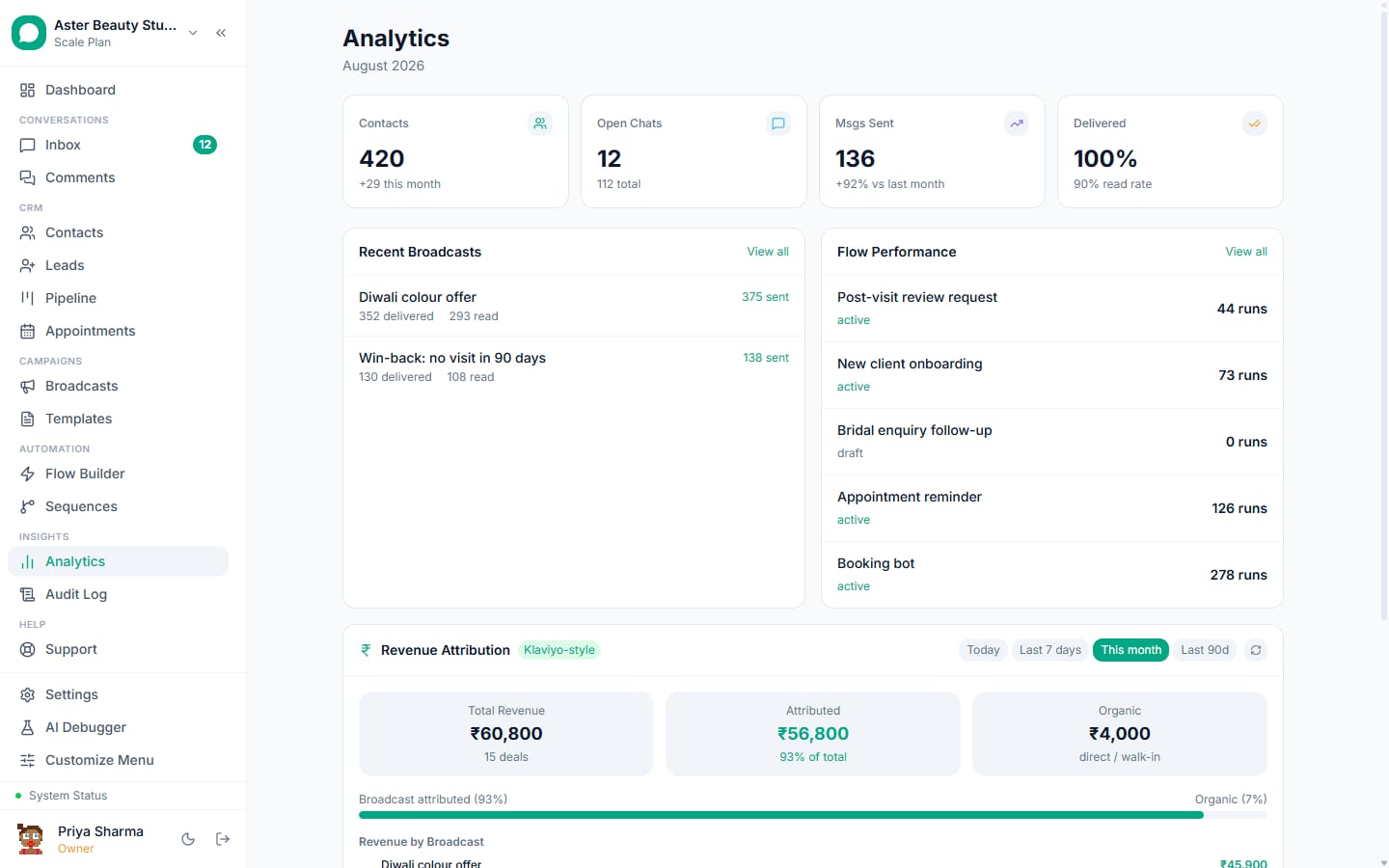
VGraple CRM runs the WhatsApp side: broadcasts with segments, cost estimates and delivery protection, utility automation, sequences, replies in a shared inbox, and revenue per campaign. Email tools connect through Zapier or webhooks so a lead captured on WhatsApp lands in your email list with its consent recorded, and vice versa.